Villa del Balbianello, Lake Como, Italy
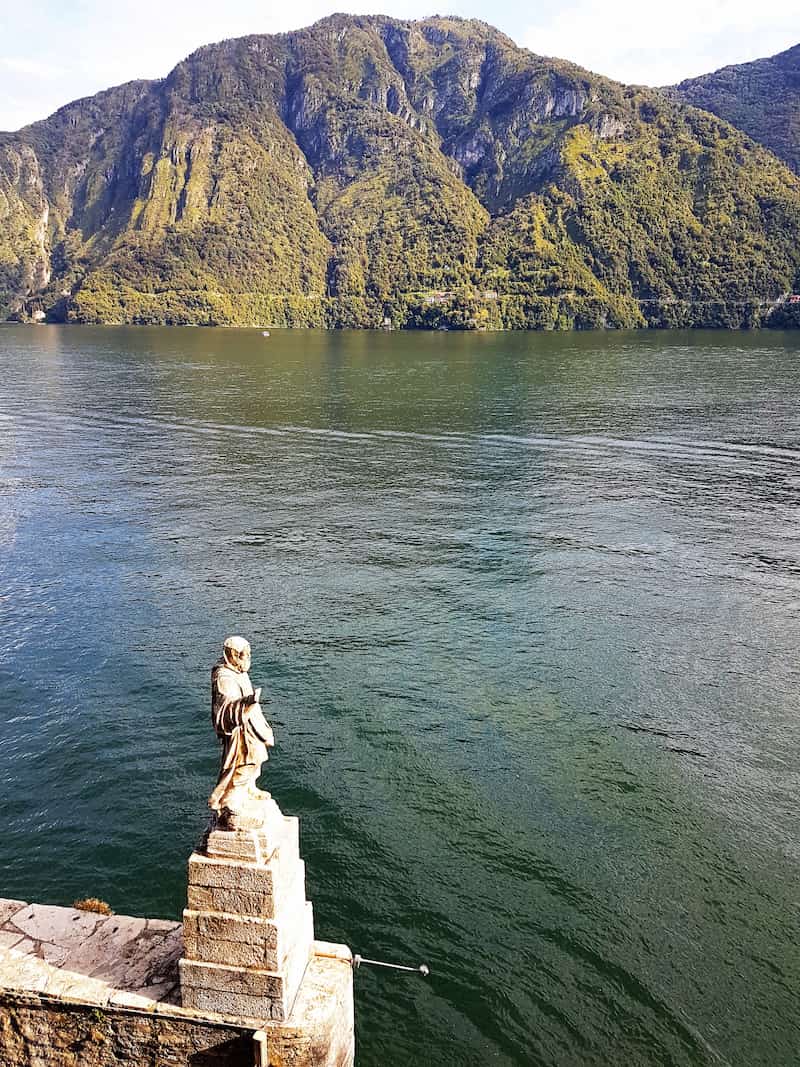
It would have been hard work indeed to clear the rock of native vegetation and build a chapel for worship. The bell towers are still visible today and a statue of a saint, perched on the balustrade, welcomes the visitor, a reminder that this once was holy ground, an admonition that one could be close to the divine.
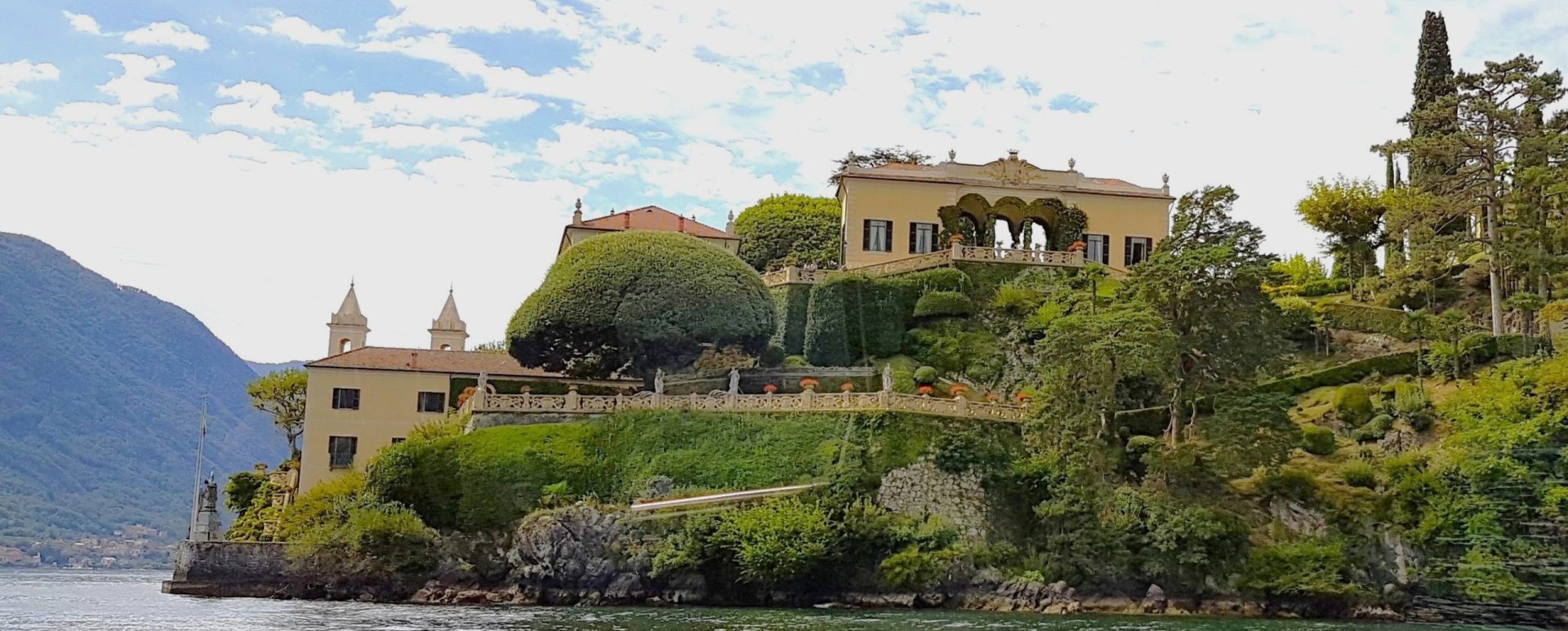
Apart from the bell towers, the villa’s outside appearance today is largely due to Cardinal Durini (1725-1796) who in 1787 built himself a summer residence here. He is responsible for the famous loggia and the two pavilions which stand at the top of the site, affording views of the lake both to the North and to the South. From 1919 to 1954, former US Congressman Butler Ames (1871-1954) bought the property and restored the house and gardens. In 1974 his heirs sold it to Guido Monzoni (1928-1988) who used it as his personal hideaway.
A passionate traveler and explorer, Monzoni led the first Italian expedition to the Himalayas, the last of a series of about 20 such trips in as many years. The 1970’s were a turbulent time to be the scion of a retail dynasty and his fear of being kidnapped led Mr. Monzoni to establish residence at Villa Balbianello.
He connected the buildings with secret passageways but there are only two bedrooms: one for him and one for his mother. Clearly his intention was not to hold house parties. Rather this is where he sought peace and quiet, perhaps in keeping with the place’s monastic origins.
The Garden
The boat docks at the villa’s private pier, which leads to stone steps, the entrance to the garden. At the top of the stairs begins a steep path. Craning your neck to look up, you catch a glimpse of the villa up top.
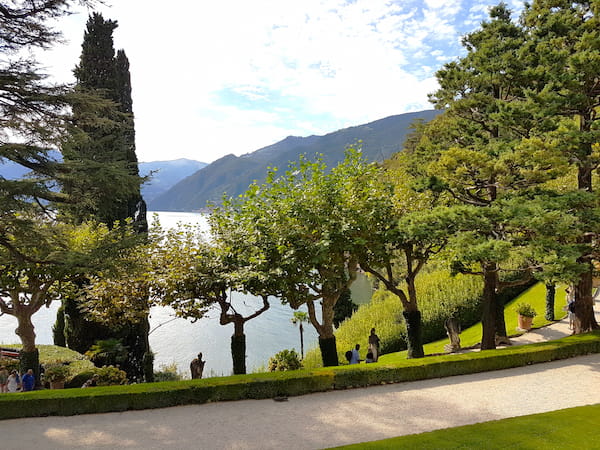
In the garden all is curves and rounds, as if to soften the roughness of the rocky site. On the lake side of the path the plane trees are perfectly clipped in the shape of candelabra. The cliffs below are planted with azalea; the growth is so dense that it looks like a soft cushion. To the right the lawn is gently fenced off with cordons of ivy, expertly shaped.
How does one mow the lawn on such a steep slope, I wonder?
The answer is, I gather, to plant a lot of dwarf lilyturf (Ophiopogon japonicus).
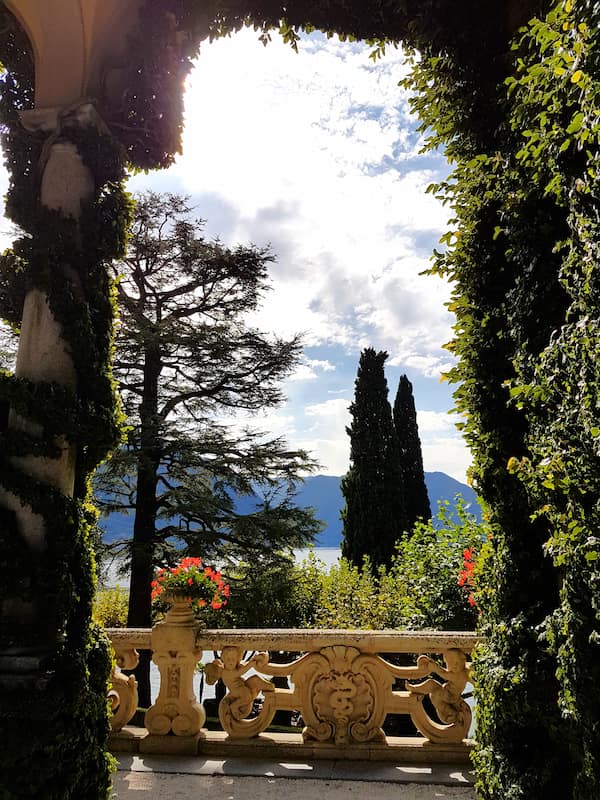
Continuing up the path you come to a terrace where a large camphor tree (cinnamomum camphora) provides shade. A wooden bench invites the visitor to sit and take in the surroundings. It is advisable to do so before proceeding to the next level, the 18th century covered loggia. There views of the lake in both directions are almost overwhelming. Creeping fig (ficus repens), clipped in a netting pattern, is trained up the columns, framing the view dramatically.
Below the Loggia an evergreen oak (quercus ilex) dominates the lawn. The gardeners keep its canopy trimmed precisely so as to not obstruct the view from inside the Villa. At the edge of the lawn the cliff drops down to the water. There is a balustrade dotted with pots of seasonal blooms, a touch of color in this otherwise very green and mineral garden. In spring, the wisteria blooming on the terrace offers an added touch of color.
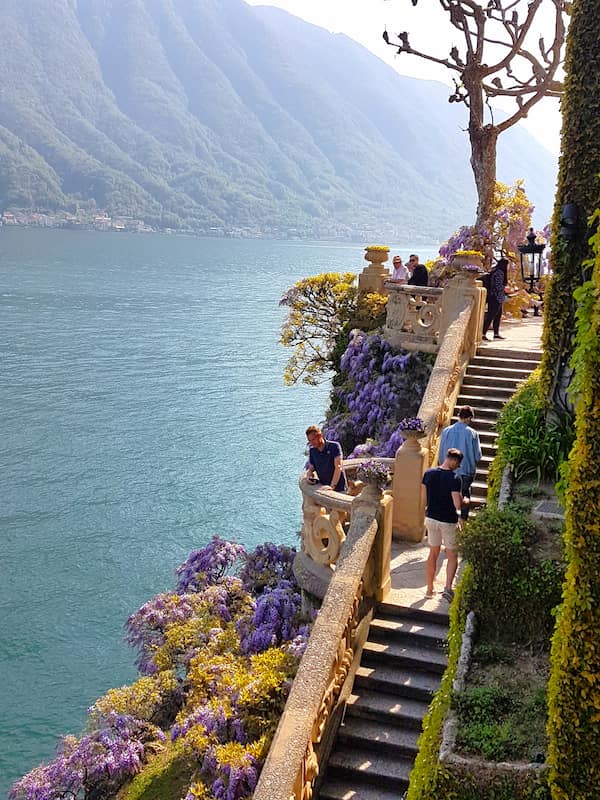
A lot of work goes into the maintenance of this garden, that is evident. The shrubs, lawns, trees, everything is neat and precisely tended. The expression “manicured” is not out of place. In fact the creeping fig on the loggia is trimmed with scissors by hand, so we were told. Every blade of grass, each leaf, each blossom, has its raison d’être, having been carefully groomed to play a precise part in the overall composition.
This garden is not about color. It is about neatness and precision, in sharp contrast to the deep waters of the lake and the forests and rocky crags beyond. It is about taming nature and fulfilling its promise as a civilized hideaway from the outside world, true to its monastic past.
The House
In the house what you see is the interior as left by Guido Monzino (1928-1988), the last private owner who donated the property to FAI, the Italian equivalent of the National Trust, upon his death. The decor reflects his passion for travel and faraway expeditions, to the Arctic, the Himalayas and Africa.
The map room, right off the loggia at the very top of the promontory, has windows on three sides with views of the lake and the Alps beyond. It holds a large table, to lay out maps. What a great place to dream of faraway lands, inspired by the infinite blue of the lake outside. Upstairs in the main house is a museum with the various memorabilia of his arctic and Himalayan expeditions. There are also noteworthy Inuit artifacts and artworks dating back to antiquity.
Mr. Monzino had a soft spot for 18th Century French furniture and there are some fine pieces throughout. For the smoking room he imported period wood panels from a chateau in France. As these were too high for the existing walls he dug down a couple of feet to lengthen the walls and install the paneling. That explains why you go down a few steps to reach this room. By the way, you will see ashtrays, large ones, in every room, a reminder that Mr Monzoni died of emphysema.


Conclusion
Perfection!
And how very rare it is to find perfection in a historic garden, one that is managed by a public entity. Often such gardens are soulless, stuck in the past and stale.
Villa del Balbianello feels vibrant and very much in its time. FAI’s expert maintenance keeps alive both the spirit of the founding monks and that of its last private owner, the explorer and dreamer Guido Monzoni.
Opening hours (updated 2026):
Open March – January. Open every day except Monday and Wednesday. From 10am-6pm.
How to get there:
To best experience the drama of the place it is preferable to arrive by boat, for example by taking a water taxi from Lenno. You can also walk from the village (about 1,5km), a rather dramatic walk through the woods
My tour of the gardens of the Italian lakes

Via private boat tours we’ll visit the Villa del Balbaniello, as well as the gardens of the Borromean Islands, view the dramatic terraces of the magical Villa Carlotta and much more.