
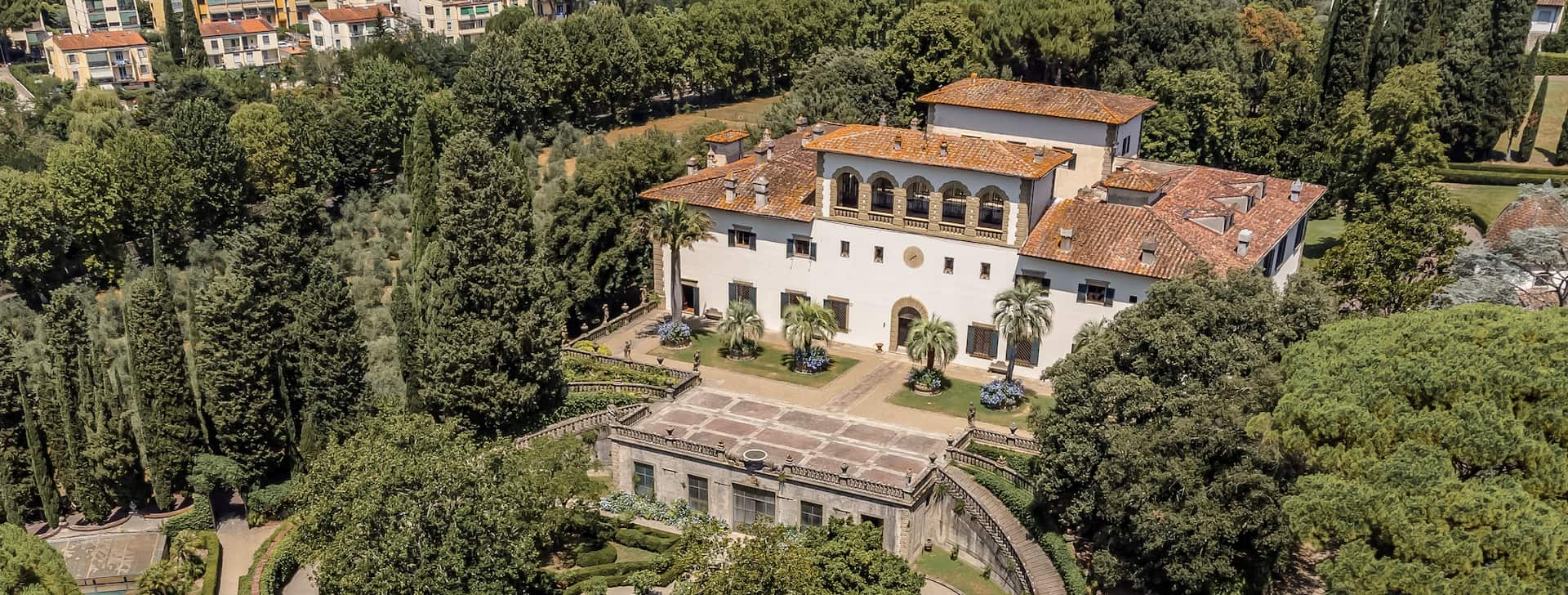
Villa Palmieri in Florence- A Delightful Garden
Sometime in July 2023, an invitation arrived in my inbox from the Rocco Forte Group. Would I care to join other special interest travel specialists for three nights in Florence and Rome, not only to discover their beautiful five-star hotels in those iconic cities but also for three days of discoveries off the beaten path?
As you can imagine, it didn’t take me long to say yes. That is how mid-November found me in Florence, joining a small group of 10 other tour operators and travel agents. The program covered all our specific areas of interest. There were concerts, visits to private art collections and private palazzi, and, to my delight, visits to secret gardens.
I thought I knew Florentine gardens pretty well, having scouted the area in preparation of a tour of historic gardens of Italy two years ago. In the heat of July 2021, I had explored Florence and the surrounding hills, marveled at The Boboli gardens, fell in love with the Bardini Gardens, cursed the narrow roads to Villa Gamberaia in Settignano only to be bawled over by the view, admired Villa Medici in Fiesole, learned about Bernard Berenson and Cecil Pinsent at Villa I Tatti. I thought I knew my stuff.
So I was particularly intrigued when our program stated that we would visit Villa Palmieri in Fiesole. I had never read about nor heard about Villa Palmieri which is only a short drive from the center of Florence.
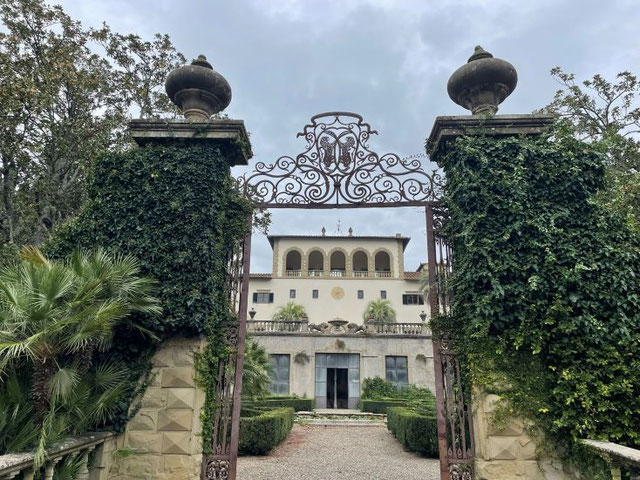
Well, it turns out Villa Palmieri is the second largest garden in Florence, second only to the Boboli, with 25 hectares. Villa Palmieri is famous for two things. First it is thought to be the setting of the Decameron, Giovani Bocaccio’s great poem published around 1349. Second, this is where Queen Victoria stayed when she came to Florence on three occasions in 1888, 1897, and 1898.
A little History
The villa takes its name from the humanist scholar Matteo di Marco Palmieri (1406–1475), who first purchased the villa in 1454 from the Fini Family. The description in Bocaccio’s poem gives a sense of the place:
To see this garden, its handsome ordering, the plants, and the fountain with rivulets issuing from it, was so pleasing to each lady and the three young men that all began to affirm that, if Paradise could be made on earth, they couldn’t conceive a form other than that of this garden that might be given it.– Giovani Bocaccio, 1349
The villa stayed in the Palmieri Family for the better part of 200 years and it is Palmiero Palmieri who is thought to be responsible for the first restructuring of the gardens, creating a south-facing terrace, an arcaded loggia and the double staircase leading up to the villa, all in the late 17th century.
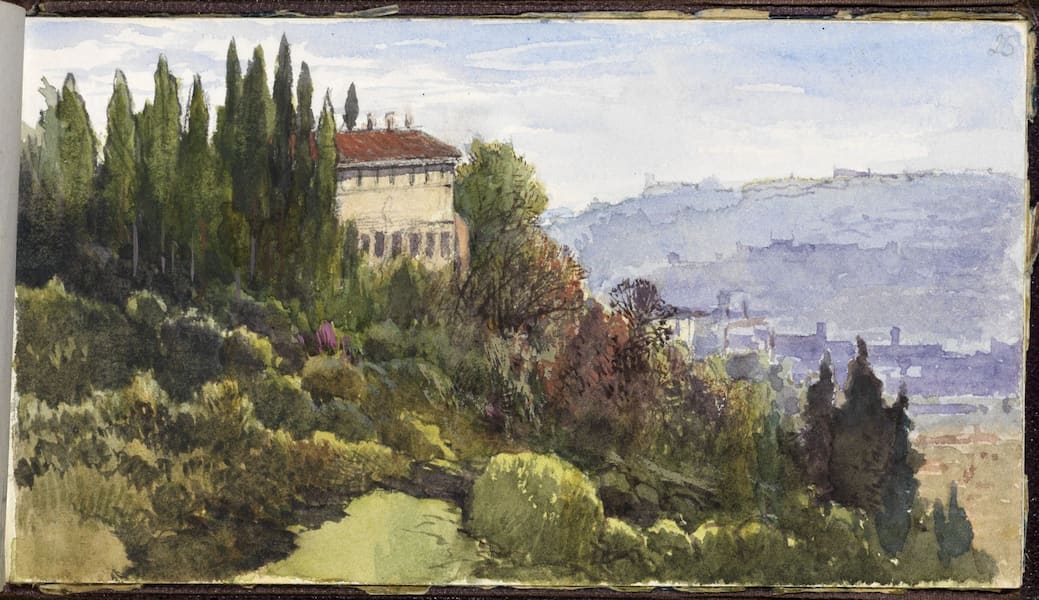
A century later, in 1873, another Englishman, the Earl of Crawford, James L. Lindsay (1847–1913), purchased the property and remodeled the grounds in the then fashionable English landscape style. It was as a guest of his mother, the Dowager Countess of Crawford (1824–1909), that Queen Victoria (1819–1901) spent a month here in April 1888. She was to return twice more, in 1893 and 1894.
In 1907, the villa was sold to American industrialist James Ellworth (1849–1925), who lived there until his death in 1925.
The family who owns the property today took it after the Second World War.
The Garden
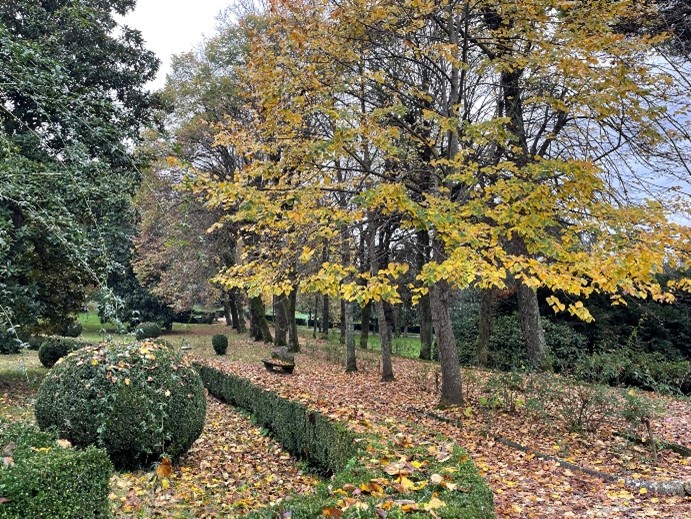
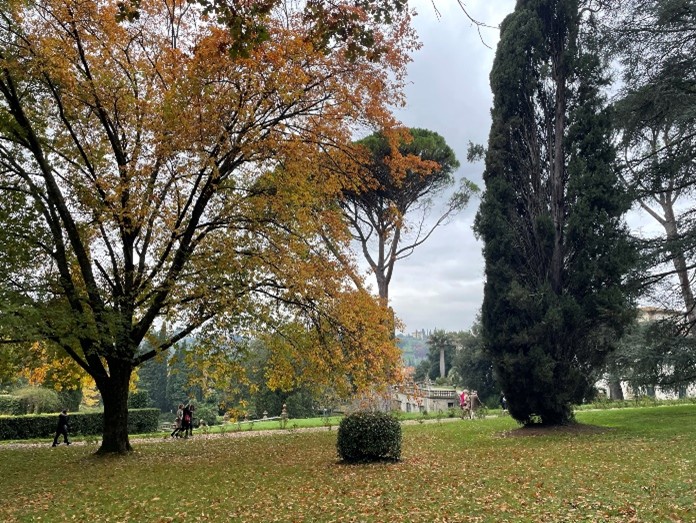
Visiting gardens in November, even in Florence, is a true test. There are no flowers; the lush green of summer is gone and the garden is devoid of ornament, exposed down to its bones. Well, the bones of Villa Palmieri, are not only eminent but excellent.
The villa sits nestled in the hills, surrounded by sloping grounds. There are no obvious terraces here, just gentle upward paths connecting the various parts of the garden.
The winding path leading up from the driveway into the garden is lined on either side with a knee-high, thick boxwood hedge. Considering how rare a healthy boxwood hedge has become, at least here in Northern Europe, I was pleased to see that the boxwood here is in good shape. However, so I was told, the four gardeners are very vigilant against the moth (Cydalima perspectalis) and need to spray regularly to keep it in check.

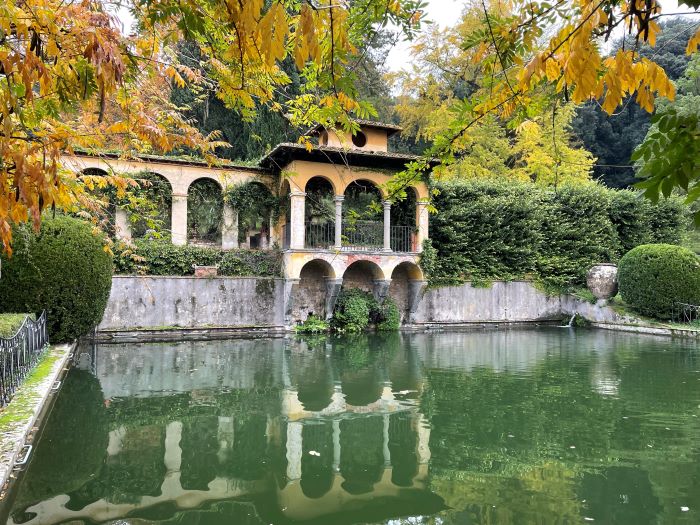
A pergola, covered in Wisteria and roses, forms a covered walk around a pool, where water spouts from the mouth of a gargoyle. Exposed to a breeze down the surrounding slopes, protected from the shade by the foliage of the wisteria, and lulled by the cooling sound of the fountain, this must be a very pleasant place to spend a hot summer day.
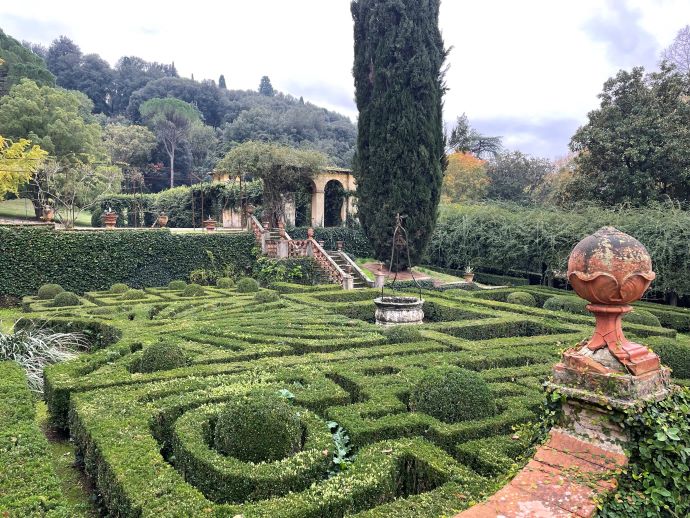
From the abandoned tennis court above, the visitor can look down onto an intricate boxwood parterre, the most formal part of the garden.
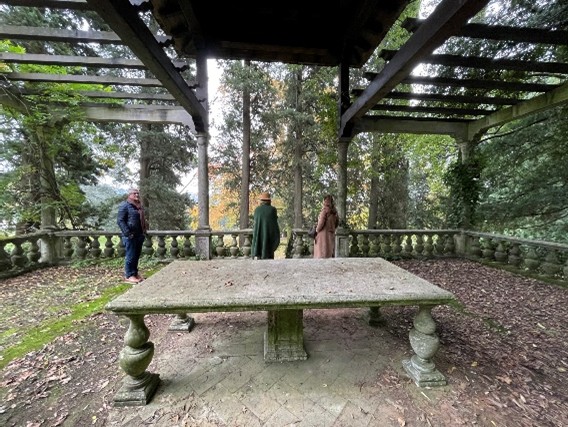
A few steps up lead to a rectangular gazebo, in the shade of evergreen oaks, which is the spot where Queen Victoria liked to enjoy afternoon tea. The gazebo was built especially for her.
The view from up there is down into the valley and onto the other side, dotted with olive and cypress trees.
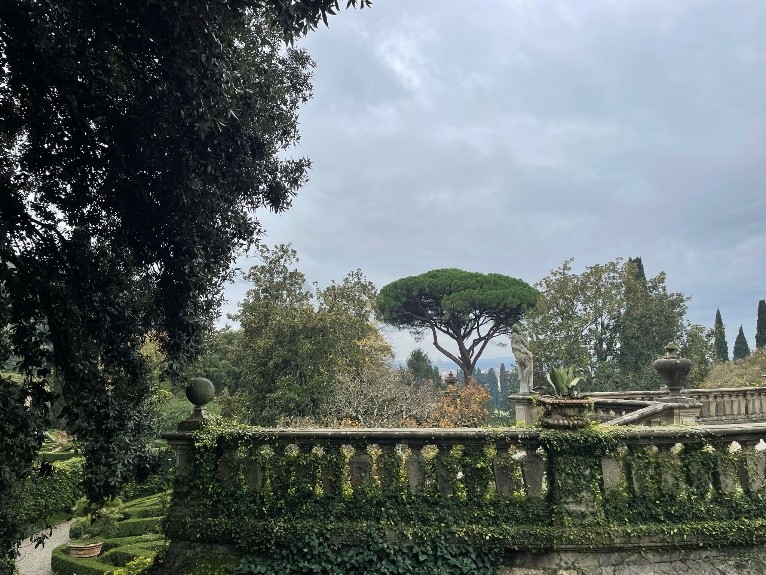
The surrounding park showcases specimen trees, for instance, large Gingko (fiery yellow at this time of the year) and a camphor tree. The trees lining the allee up to the house are enormous centenary oaks.
A Garden with a Soul
While purists might, in the words of garden historian Georgina Masson (1912–1988), say:
Villa Plamieri has suffered from having been a show-place and the alterations of many owners to suit the fashions of their day, so that little of its original character remains.– Georgina Masson (1912–1988)
I found the garden at once grand and charming. It is a place with a soul and a living one at that.
Historic gardens can sometimes feel static and stuffy, weighted down by the eminence of their creators or the importance of their historical significance. They can also sometimes feel neglected and overgrown. It is a though the weight of the past is so great that it crushes yes stifles the vitality of the present.
At Villa Palmieri, I felt, the successive owners have each left their distinctive mark on the garden. Yet the whole is cohesive and harmonious, respectful of the spirit of the place. It feels like a garden with a long history of having been loved by many owners with both vision and deep pockets. The current owners maintain it beautifully, respectful of its past and its soul, well aware of its value today.
This is a garden I can’t wait to return to and include in my next tour of Tuscan gardens.
Shall we go?
If you’d like to join me on a tour here or have a question, send me a message here.


