
Why We Travel to Gardens and How to Bring the Inspiration Home
I travel to gardens for many reasons: to see extraordinary places, to meet the people who create and care for them, and, perhaps most importantly, to come home with new ideas. That is the heart of garden inspiration from travel.
Sometimes it’s a planting combination that catches my eye. Sometimes it’s a clever way of using a space, an unexpected color scheme, or simply the pleasure of seeing a familiar plant growing in a completely different setting
And sometimes, of course, it’s just the sheer delight of being somewhere beautiful.
But I’ve come to realize that the best garden visits aren’t necessarily the ones where you see the most. They’re the ones where you have time to look, to ask questions, to absorb an atmosphere and to discover something you might never have thought of yourself
I know this from experience. And, as it happens, I have a rather good example involving 500 tulips.


The tulips that didn't come up
About ten years ago, I planted 500 tulips in my garden. The following spring, not one appeared. I live somewhere with a lot of voles, and they had clearly enjoyed a very good winter.
Then I started taking groups on tulip tours in the Netherlands. I saw pots overflowing with bulbs and came home determined to try again. I read up on lasagna planting, which involves layering bulbs at different depths so that successive varieties flower over a longer period. I ordered accordingly and planted my pots for a succession of color from March to late May.
It worked beautifully. Until a hailstorm in late May beheaded every last tulip.
Still, I had learned something. And that, in a nutshell, is what a garden trip can do. You don’t necessarily come home wanting to recreate an entire garden. You come home with one idea, one technique, one combination of plants that you hadn’t considered before.
The tulips were a success, even if their careers were rather short-lived.
Wonder, in specifics
People often ask me which gardens have made the greatest impression on me. It’s a difficult question, because the answer depends very much on what we’re looking for.
Some gardens impress through their scale and ambition. Others through the imagination of their owners, the quality of their planting or the way they make you feel.
Three very different examples come to mind.
Casa do Casal, Portugal: the pleasure of abundance

Casa do Casal is one of those places that reminds you just how rewarding it can be to grow a garden in a different climate.
I visited in March, when the camellias were in flower. And what camellias! So many varieties, in such a wonderful range of colors and forms, that after a while I gave up trying to count them. (I wrote about Porto’s camellias earlier this year.)
There is something particularly exciting about seeing a plant you know well presented in a way you hadn’t quite imagined. In a northern European garden, camellias can feel like precious specimens, plants to be carefully positioned and protected. In Portugal, they can be part of a much more generous display.
It makes you think about the possibilities of a garden when climate, space and the right choice of plants come together. It also makes you look at your own garden differently. What might you grow if you weren’t always thinking about what might not survive the winter?
I came away with that familiar mixture of admiration and inspiration: the pleasure of seeing something extraordinary, and the temptation to rethink what might be possible at home.
Kiftsgate Court, England: a garden with a personality

Kiftsgate is a very different experience. I particularly remember wandering through the rose garden with the owner, Anne Chambers, while the roses were in full flower. (More in my post on Hidcote and Kiftsgate.)
A rose garden can be a beautiful thing, but it can also be overwhelming. There are so many varieties, colors and forms, and it’s easy to become absorbed in the plants themselves. What makes a visit with an owner so special is the opportunity to understand the thinking behind the garden: the choices, the experience accumulated over years, and the personal relationship between a gardener and the plants they grow.
At Kiftsgate, the roses were not simply there to be admired. They were part of a living garden, with all the character and individuality that comes from years of care and attention.
And then there is the scent. Photographs are wonderful for remembering a particular rose or color combination, but they cannot recreate the experience of walking among roses in full bloom. Nor can they capture the pleasure of hearing the person who knows the garden best talk about it.
For me, this is one of the great privileges of visiting private gardens: the opportunity to meet the people behind them. A garden is never quite the same when you understand something of the hands, decisions and stories that have shaped it.
Potsdam, Germany: the beauty of the useful

At the Orangery in Potsdam, I was struck by something rather different.
Here were vegetables and herbs arranged in borders, not simply as a practical kitchen garden but as a beautiful ornamental composition.
It’s an idea I love. We tend to think of ornamental gardens and productive gardens as two separate things. One is for looking at; the other is for eating. But why should they be separate?
Vegetables have wonderful foliage, flowers and forms. Herbs offer texture, scent and often a long season of interest. A well-planted vegetable border can be every bit as attractive as a traditional flower border, and it has the added advantage of providing something for the kitchen.
It is also a reminder that beauty doesn’t have to be complicated or expensive. Sometimes it’s simply a matter of looking at familiar plants in a different way and giving them a different role.
I came away thinking about how much more we could do with vegetables and herbs in our own gardens, even on a modest scale. A few rows of attractive vegetables, interspersed with flowers and herbs, can be both productive and ornamental.
Three gardens, three very different experiences: the exuberance of camellias, the romance and personality of a rose garden, and the unexpected elegance of vegetables and herbs. Each has something to teach us, and none requires us to copy it exactly.
You can read about all three gardens, and photographs will give you a good idea of what they look like. But they won’t give you the scent of the roses, the atmosphere of Casa do Casal in March, or the pleasure of discovering that a vegetable border can be every bit as beautiful as a flower garden.
A garden is experienced with the whole body. That’s why a visit stays with you.
What I got wrong in my first years

In my first three years in the business, I tried to fit in as much as I could. I assumed that travelers wanted to see everything, so I packed every day with visits.
Then I began to notice something. People couldn’t always remember where they had been. They were tired, sometimes overwhelmed, and the trip began to feel like a marathon rather than an opportunity for discovery.
So I changed my approach. Less is more. Fewer gardens, more time in each.
It made a considerable difference. There is a world of difference between rushing through a garden with an eye on the clock and having the freedom to stop, sit down, go back to a particular border or ask the head gardener a question.
And the more I thought about it, the more I realized that this was how I wanted to visit gardens myself.
Slow down, then take the photograph

My habit now is to stand still for a few minutes before taking a single photograph. I want to get a feel for the place before I start recording it.
What is the atmosphere? Where does the eye go first? What sounds can I hear? Is there a particular view that draws me in?
Only then do I reach for my camera.
Photographs are useful, of course. They are wonderful memory prompts when you get home, especially if you’ve seen dozens of gardens in a week. But I also like to make sure I know the names of the plants that have caught my attention.
If possible, I ask the gardener or owner. I take a photograph and make a note of the name. Plant identification apps can be helpful, but I find they aren’t always reliable (particularly when several similar varieties are involved).
Some of my travelers keep notebooks. Others sketch, which I think is a lovely way of really looking at a garden. You have to slow down and pay attention to shape, proportion, color and detail. I’d love to build a little sketching time into one of my tours one day.
The gardens that hold you
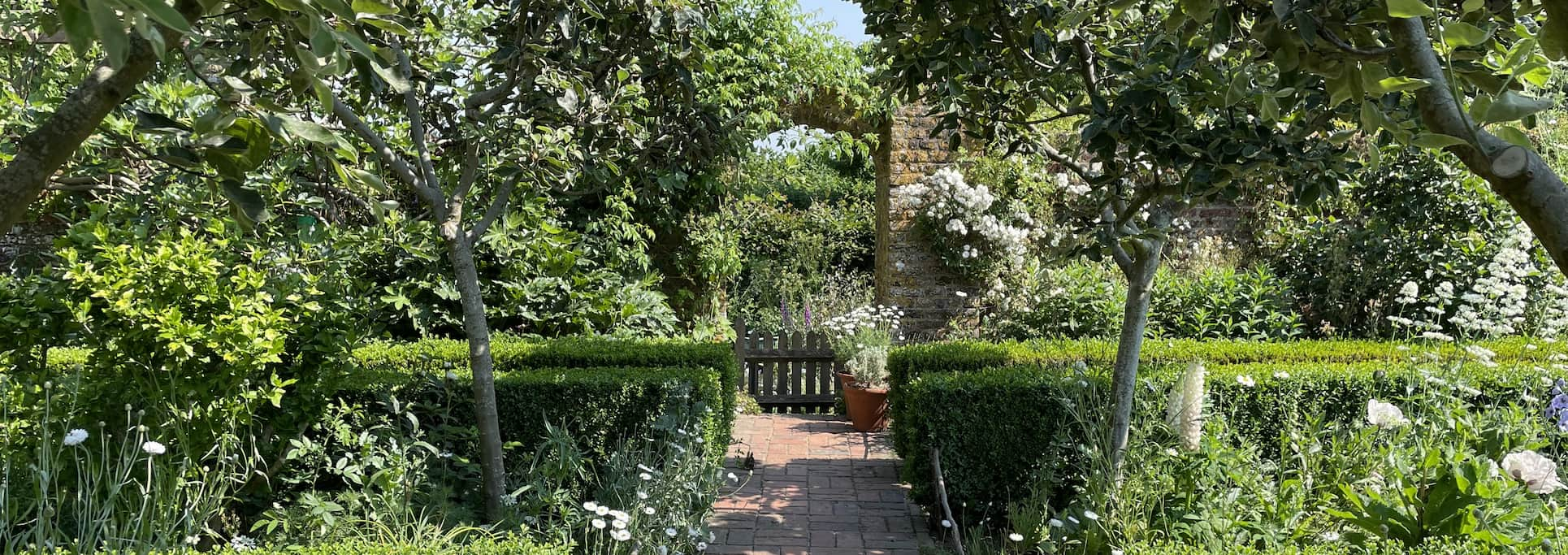
The two gardens where I most wanted to stay are Sissinghurst in England and Les Jardins de Castillon in Normandy.
Both are organized as a series of garden rooms, each with its own mood and character. You move from one space to another, and each offers a different experience. A change of planting, a shift in color, a different sense of enclosure or openness.
What I particularly enjoy is that you can retrace your steps and see something quite different. A path that seemed unremarkable on the way in suddenly becomes interesting on the way back. The light has changed, your attention has shifted, and the garden reveals another side of itself.
I could spend hours doing this. There is no need to rush towards the next attraction or tick off another famous feature. You simply wander, look, pause and wander again.
That is what I increasingly look for in a garden visit, and what I try to build into my tours: places where there is room to slow down and notice.


Bringing garden inspiration home
Bringing plants home from Europe can be complicated. There are regulations, practicalities and, depending on where you live, restrictions on what you can take across borders.
But inspiration travels rather more easily.
One of my travelers once took home seeds for a botanical art project for her garden club’s show. I would never have guessed that particular outcome, but that’s precisely the point. We all respond to gardens differently, and what stays with one person may be quite different from what stays with another.
Sometimes it’s a planting idea, a combination of colors, a way of arranging pots or a new appreciation of a particular plant. Sometimes it’s a practical solution to a problem in your own garden. And sometimes it’s simply the realization that you’ve been thinking about a particular space in the wrong way.
The big idea rarely travels. The small one does.
A pot, a plant combination, a way of dividing a border, the thought of mixing vegetables with flowers. These are the things that find their way home and gradually become part of our own gardens.
Travel with a purpose
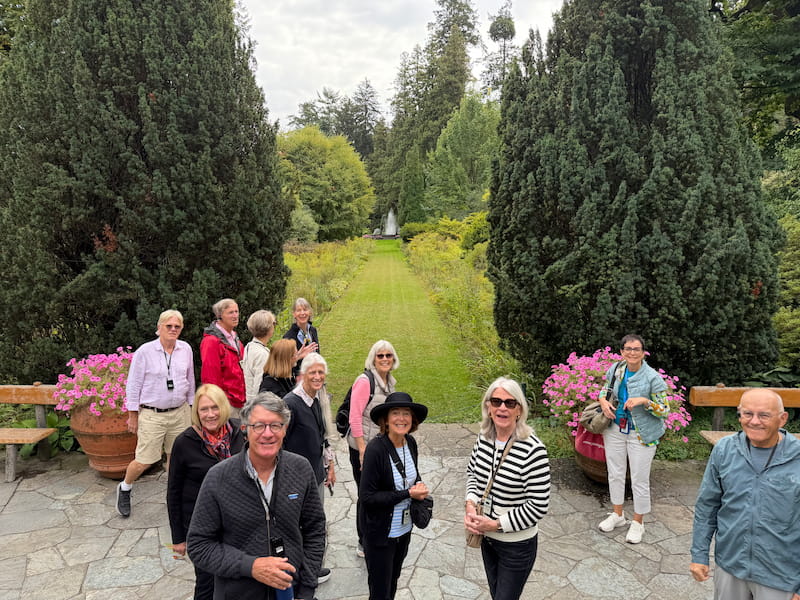
Choosing gardens as the focus of a trip gives travel a particular pleasure. You travel to discover, to learn and to be inspired. You meet people who are passionate about what they do, see places you would probably never find on your own, and return home with ideas that continue to develop long after the journey has ended.
And perhaps that’s the real value of garden inspiration from travel. It’s not simply about seeing beautiful places. It’s about coming home with a slightly different way of looking at your own.
If you’d like to read more about why we garden in the first place, I wrote about it after visiting the monastery of São Martinho de Tibães in Portugal.
And if you’d like to experience gardens this way, with time to explore and opportunities to meet owners and head gardeners, take a look at my Ireland garden tour in July 2027 and my other upcoming tours. I’d be delighted to welcome you


